
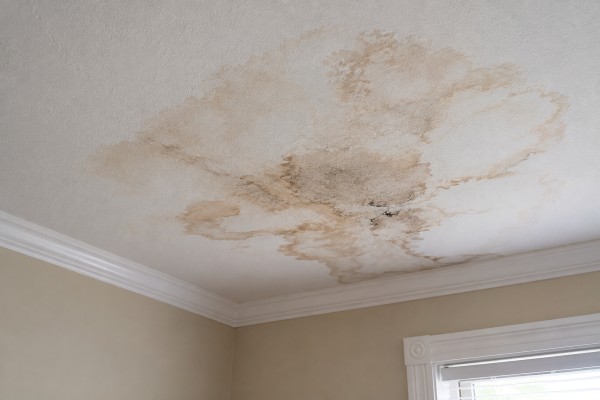
By the Time You See That Stain, the Damage Behind It May Already Be Worse Than You Think
You noticed it after the last rainstorm. A brownish ring on the ceiling. Maybe a small damp patch. Maybe just a discoloration you’ve been meaning to look into.
Here’s the thing: a water stain on the ceiling after rain is one of the most misread signals a home gives you. Most people assume it’s minor. Some assume it’ll dry out and go away. A few assume it’s a plumbing issue. And some — the ones who catch it early — understand that it could be coming from the roof above them.
This article helps you figure out which situation you’re in.
What a Water Stain on Your Ceiling After Rain Is Actually Telling You
A ceiling stain that appears or worsens after rain is narrowing the source for you. Rain-triggered staining points to one of three things: a roof problem, an HVAC condensation issue, or a window or wall leak allowing water in along the exterior.
Plumbing leaks rarely correlate with rain. If your stain appears consistently after rainfall and dries out between storms, your plumbing is almost certainly not the cause. The roof, however, is worth looking at seriously.
What makes roof-sourced ceiling stains tricky is that water doesn’t travel straight down. It enters through a breach in the roofing system — a cracked shingle, failed flashing, or compromised seal — and travels along rafters, insulation, or drywall until it finds somewhere to pool. The stain you see on your ceiling may be several feet away from where water is actually entering the roof.
How to Tell If the Ceiling Stain Is Coming From Your Roof
You don’t need to get on the roof to start diagnosing this. Here’s what to check first from inside and outside the home.
From the ground outside:
- Walk the perimeter and look for missing, cracked, or visibly damaged shingles
- Check gutters for excessive granule buildup — granules look like coarse sand and indicate shingle wear
- Look at flashing around chimneys, vents, and skylights for gaps or rust
From inside the attic (if accessible):
- Look for daylight coming through the roof decking
- Check for dark staining, soft spots, or active moisture on the insulation or decking boards
- Note whether the stain location below corresponds to a penetration point above (vent, skylight, chimney)
What the stain itself looks like:
- A roof leak stain is typically yellowish-brown, irregular in shape, and may have a faint musty smell
- It often appears at or after the first significant rain following a period of dry weather
- It may grow in size storm by storm if left unaddressed
If your attic shows active moisture, daylight through the decking, or soft spots in the wood — that is no longer a diagnostic question. That is an active roof problem.
Why Ignoring a Ceiling Water Stain After Rain Is a Costly Mistake
Here is the sequence most homeowners don’t see until it’s too late.
Water enters through a small breach — a cracked shingle, a separated flashing joint, a failed vent boot seal. In the early stages, the damage is contained. A targeted repair costs a few hundred dollars.
Left unaddressed, water begins saturating the underlayment. Then the decking. Saturated decking softens, loses structural integrity, and eventually requires replacement — which adds significant cost to what was originally a simple repair.
From there, water reaches the insulation and the ceiling drywall. Mold can begin forming within 24 to 48 hours of sustained moisture. By the time a homeowner sees a visible ceiling stain and calls a contractor, the damage visible on the inside is often the smallest part of what’s actually there.
The repair cost at each stage:
- Small breach, caught early: repair in the hundreds
- Underlayment compromised: repair in the low thousands
- Decking replacement needed: mid-to-high thousands
- Interior damage, mold remediation required: costs that compound across multiple trades
A ceiling stain after rain is your roof’s earliest warning. The stain itself costs nothing to address if you act while it’s still a roof problem and not a structural one.
Is a Ceiling Stain Always a Roof Problem? Not Always — Here’s How to Rule Out Other Causes
Before assuming the worst, eliminate the alternatives.
HVAC condensation: If the stain is near a ceiling vent or air handler and appears during humid weather regardless of rain, condensation from the HVAC system is a likely cause. Check whether the stain correlates specifically with rainfall or with the AC running.
Window or exterior wall leak: If the stain is near an exterior wall or window, water may be entering through gaps in caulking or flashing around the window frame rather than through the roof.
Upstairs bathroom or pipe: If there’s a bathroom directly above the stain, a slow pipe leak or failing toilet wax ring is worth ruling out — though again, these typically don’t correlate with rain.
If the stain appears specifically after rain, worsens with heavier rainfall, and is located away from windows and plumbing, the roof is the most likely source and should be inspected by a professional.
What to Do Next If You Suspect Your Roof Is the Source
Don’t get on the roof yourself. Don’t apply roof sealant to something you can’t fully diagnose from above.
Schedule a professional inspection. A trained eye on the roof surface can identify the actual breach point — which, as noted, may not be directly above the stain. A proper inspection documents what’s found with photos, explains the source in plain language, and gives you a clear picture of whether you’re looking at a minor repair or something larger.
If the inspection reveals widespread shingle wear or damage beyond a contained repair, understanding the signs that asphalt shingles are failing will help you know what you’re dealing with before anyone hands you a quote.
And if replacement turns out to be the honest recommendation, the asphalt shingle roof replacement page walks through what that process actually looks like — from materials to cost to what happens on the day of the job.
A ceiling stain after rain is not a reason to panic. It is a reason to act before it becomes one.