
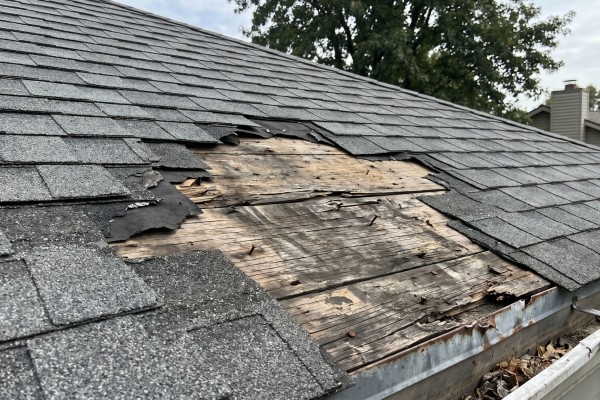
Your Roof Is Sending Signals Right Now — Here’s How to Read Them Before It’s Too Late
Your roof doesn’t fail all at once. It fails gradually — and the signs are there long before a ceiling stain appears or a leak shows up during a rainstorm. The problem is most homeowners don’t know what to look for, or they see the signs and misread them as cosmetic.
This article breaks down what asphalt shingle failure actually looks like, what each sign means structurally, and how to assess your roof without getting off the ground.
What Granules in Your Gutters Are Actually Telling You
Granules are the small, sand-like particles embedded in the surface of asphalt shingles. They serve a critical function: they shield the underlying asphalt from UV radiation. Without them, the asphalt dries out, becomes brittle, and begins cracking.
Finding granules in your gutters after rain or after cleaning them out is one of the earliest and most reliable signs that your asphalt shingles are degrading. Some granule loss is normal on newer roofs — the first few months after installation. On a roof that’s 10 or more years old, significant granule accumulation in gutters means the shingles are losing their UV protection and accelerating toward the end of their useful life.
What to look for: if your gutters contain what looks like coarse dark sand — particularly after rain — your shingles are shedding. The more granules, the further along the degradation.
What Curling and Cupping Shingles Mean — and Why It’s More Than a Visual Problem
Shingles curl in two ways. Cupping is when the edges of the shingle turn upward, creating a concave surface. Curling — or clawing — is when the middle of the shingle lifts while the edges stay flat.
Both are caused by moisture imbalance. The top surface of the shingle is absorbing or releasing moisture at a different rate than the underside. This is often caused by inadequate attic ventilation, which traps heat and moisture beneath the shingles and accelerates aging from below at the same time UV is attacking from above.
Curled or cupped shingles are no longer lying flat against the roof deck. That means they are no longer forming a sealed surface. Wind can get underneath them. Water can migrate under the edges during rain. And they are significantly more vulnerable to being lifted or torn off during a storm.
If you can see curling from the ground — using binoculars if needed — those shingles have already lost a significant portion of their protective function.
Can I Tell If My Shingles Are Failing Without Going on the Roof?
Yes — and you should not get on the roof to assess this yourself. Here is what you can check from the ground.
With your eyes from the driveway:
- Look for shingles that appear darker than surrounding areas — this indicates moisture retention or significant granule loss
- Look for patches where shingles appear to be lifting at the edges
- Look for any visibly cracked, broken, or missing shingles
- Check the ridge line — ridge caps deteriorate faster than field shingles and show early signs of wear
With binoculars from a safe vantage point:
- Check flashing around chimneys, vents, and skylights for gaps or rust
- Look for blistering — small bubbles on the shingle surface caused by trapped moisture or manufacturing defects
- Check valleys (where two roof planes meet) for cracking or exposed substrate
From the gutters:
- Pull the downspout strainer and check for granule accumulation
- Look inside the gutter channel for dark grit collecting at the outlet
Any combination of these signs — especially on a roof that is 15 years or older — warrants a professional inspection.
How Long Do Asphalt Shingles Really Last? The Honest Answer
Manufacturer warranties on architectural asphalt shingles often state 25–30 years. The real-world lifespan in Central Texas is typically shorter.
Here’s why: standard shingle ratings are based on average climate conditions. Central Texas does not offer average conditions. Triple-digit summer heat accelerates granule loss. UV exposure at this latitude degrades asphalt faster than northern climates. Hailstorms impact shingle integrity in ways that don’t always show immediately but shorten the effective lifespan. And inadequate attic ventilation — common in builder-grade construction — traps heat that attacks the shingle from below.
In practice, many asphalt shingle roofs in this region begin showing meaningful failure signs at 15–18 years, and a significant portion require replacement before the 25-year warranty benchmark.
Class 4 impact-resistant shingles tend to hold up better because the modified asphalt and reinforced construction resist both impact damage and UV degradation more effectively. But even those are not immune to the cumulative effect of this climate.
What Asphalt Shingle Failure Signs Look Like at Each Stage
Understanding where your roof is in the degradation sequence helps you plan — and avoid being surprised by a failure that was visible for years.
Early warning (5–10 years remaining):
- Minor granule loss visible in gutters
- Slight color variation across the roof surface
- No active leaks, no interior symptoms
Moderate degradation (2–5 years remaining):
- Consistent granule loss, gutters filling after rain
- Visible curling or cupping on multiple shingles
- Flashing showing wear or beginning to separate
- Minor leaks possible during heavy rain events
End of life (replacement territory):
- Widespread curling, cracking, or missing shingles
- Active leaks or ceiling stains inside the home
- Blistering visible across large sections
- Adjuster or inspector recommending full replacement
If you are seeing signs from the middle or bottom of that list, you are past the repair-and-monitor stage.
What to Do When You See These Signs
Don’t wait for a leak to confirm what the shingles are already telling you. Schedule a professional inspection and get a documented assessment of where your roof actually stands.
If you’ve already noticed a ceiling stain or interior moisture, a ceiling stain after rain is often the first interior sign of a roof problem — and that article walks through how to diagnose the source before calling anyone.
If the inspection confirms that replacement is the right call, the next question is what to replace with. If you’re deciding between asphalt shingles and other materials, the asphalt shingles vs. metal and tile comparison gives you a plain-language framework for making that decision without being pushed toward the most expensive option.
And when you’re ready to move forward, the asphalt shingle roof replacement page walks through the full process — cost, materials, what happens on the day of the job, and how insurance gets handled.
Your shingles will tell you what they need. The signs are there — you just have to know what you’re looking at.
Sprauer Roofing serves Austin and the Greater Austin Area. Free 13-point inspections, no pressure, same-day response. Call or text 737-703-6290.