
Before You Pay for an Upgrade You Don’t Need, Read This First
When it’s time to replace a roof, most homeowners face the same question: do I replace it with the same asphalt shingles that were already there, or is this the moment to upgrade to something different?
It’s a fair question — and the honest answer is that it depends on five things specific to your situation. This article walks through each one so you can make a decision that actually fits your home, your budget, and your timeline — without being steered toward whatever has the highest margin.
Why the “Best Roofing Material” Question Has No Single Answer
Every roofing material comparison article on the internet has a winner. Most of them happen to favor whichever material the author installs. The reality is that the best roofing material is the one that makes the most sense for your specific situation — and that changes based on where you live, how long you plan to stay, what your HOA allows, and what your structure can support.
Here is the honest framework.
Is Metal Roofing Worth It Over Asphalt Shingles? Here’s When the Math Works
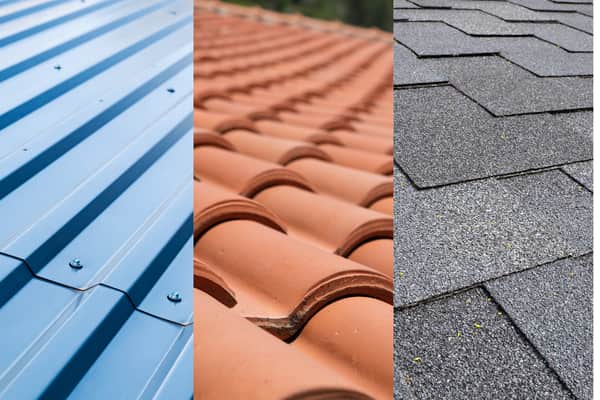
Metal roofing — particularly standing seam and Galvalume systems — lasts 40 to 70 years. That is roughly twice to three times the lifespan of a quality architectural asphalt shingle system. It reflects radiant heat, which reduces summer cooling costs. It is highly resistant to hail and wind. And it requires minimal maintenance over its lifespan.
The upfront cost is the honest downside. Metal roofing typically runs 2 to 3 times the installed cost of an architectural asphalt shingle replacement. For a roof that would cost $12,000 in asphalt shingles, the equivalent metal system might run $24,000 to $36,000 depending on the profile and pitch.
When metal makes sense:
- You plan to stay in the home for 20+ years
- You’ve had repeated hail damage and want to end the cycle of claims
- Energy efficiency is a meaningful priority — the heat reflection benefit is real in Central Texas summers
- Your HOA permits metal roofing in your neighborhood
- You want to replace the roof once and be done with it
When asphalt shingles are the more practical choice:
- Your budget doesn’t support the metal premium right now
- You’re planning to sell within 5–10 years and won’t recover the upgrade at resale
- Your HOA restricts metal roofing or requires specific color matches
- The existing structure doesn’t require additional support — metal is lighter than tile but heavier than shingles in some profiles
The cost difference between asphalt and metal is not just a price gap. It is a lifespan trade-off. If you divide the installed cost of each system by its expected lifespan, the cost-per-year numbers get much closer together than the upfront figures suggest.
Roof Replacement Material Comparison — How Tile and Synthetic Stack Up
Tile roofing (clay and concrete) lasts 50+ years, handles Texas heat exceptionally well, and delivers strong curb appeal. The installed cost is comparable to or higher than metal in most cases. The critical limitation is structural: tile is significantly heavier than asphalt or metal, and not every home is built to carry that load. A structural assessment is required before tile can be recommended. For the right home — particularly Mediterranean or Spanish-style architecture common in parts of Central Texas — tile is an excellent long-term investment. For most standard residential builds, the structural and cost requirements make it impractical.
Synthetic roofing — products designed to mimic the look of wood shake, slate, or tile using polymer-based materials — is a growing category. Synthetic shingles offer improved impact resistance and fire ratings compared to the materials they imitate, with lower weight than real slate or tile. They are more expensive than standard asphalt shingles but less expensive than true slate or tile. Their long-term performance track record is shorter than the established materials simply because the technology is newer — manufacturer claims of 40–50 year lifespans have not yet been tested over that actual time period at scale. Worth considering for specific aesthetic goals, but less proven than the established alternatives.
When Does It Make Sense to Upgrade From Asphalt Shingles?
If you are replacing your roof after a hail event with insurance coverage involved, this is the moment when an upgrade makes the most financial sense. Insurance is paying for the replacement anyway — the incremental cost to upgrade from standard architectural shingles to Class 4 impact-resistant shingles is relatively modest, and the insurance premium reduction that often follows can begin recovering that cost immediately.
Upgrading all the way to metal is a larger incremental cost when insurance is involved, but if your carrier allows it and the coverage gap is manageable, it is worth the conversation.
If your replacement is not insurance-triggered, the upgrade decision comes down to your ownership timeline. The longer you plan to stay, the more the premium materials pay off. Replacing a roof 3 years before selling rarely justifies a metal or tile upgrade — the resale premium for those materials rarely matches the cost delta in the current market.
The Honest Cost Difference Between Asphalt and Metal Roof Replacement
To make this concrete — for a typical 2,000 square foot single-story home in Central Texas:
| Material | Typical Installed Cost | Expected Lifespan | Cost Per Year |
| Architectural Asphalt | $10,000 – $15,000 | 25–35 years | $300 – $600/yr |
| Class 4 Impact-Resistant | $12,000 – $18,000 | 30–40 years | $300 – $600/yr |
| Standing Seam Metal | $22,000 – $38,000 | 40–70 years | $315 – $950/yr |
| Tile (Clay/Concrete) | $25,000 – $45,000 | 50+ years | $500 – $900/yr |
These are installed cost estimates — material plus labor — not material-only figures. The cost-per-year calculation assumes full lifespan. Actual lifespan in Central Texas varies based on ventilation, installation quality, and storm exposure.
The table shows something important: the cost-per-year difference between quality asphalt and metal is smaller than the sticker shock suggests. For a homeowner with a long ownership horizon, the premium materials can be genuinely cost-competitive over time.
What Most Homeowners Actually Choose — and Why
The majority of residential roof replacements in Central Texas use architectural asphalt shingles — and for most homeowners, that is the right call. Asphalt shingles are cost-effective, widely available, easy to repair if a section is damaged, and perform well when properly installed with adequate attic ventilation. Class 4 impact-resistant versions are increasingly common in hail-active markets and are the upgrade most worth considering for most homeowners.
Metal makes sense for a specific homeowner profile — long-term owners, hail-weary, energy-conscious, with the budget to absorb the upfront cost.
Tile makes sense for specific architectural styles and homes with the structural capacity to support it.
If you’ve confirmed that asphalt shingles are the right choice for your replacement, the signs your shingles have reached the end of their life walks through what failure looks like — useful if you’re still in the “do I need to replace or just repair” phase.
And if you’ve made your decision and are ready to move forward, the asphalt shingle roof replacement page covers the full process: materials, cost, what happens on the day of the job, and how insurance gets handled from start to finish.
The best roofing material is the one that fits your situation honestly. Now you have the framework to figure out which one that is.
Sprauer Roofing serves Austin and the Greater Austin Area. Free 13-point inspections, no pressure, same-day response. Call or text 737-703-6290.